
Contents
Overview
The story of the Greater Yellowstone Ecosystem is etched in geological time and human endeavor. Long before European explorers arrived, Indigenous peoples like the Shoshone, Crow, and Blackfeet utilized this vast territory for millennia, their lives intricately woven with its rhythms. The mid-19th century brought explorers such as John Colter, who returned with tales of geysers and boiling mud that were largely dismissed as fantasy. These accounts, however, fueled later expeditions, most notably the Hayden Geological Survey led by Ferdinand Vandeveer Hayden, which scientifically documented the region's wonders. This documentation was pivotal in galvanizing public support, leading to the establishment of Yellowstone National Park on March 1, 1872, by an act signed by President Ulysses S. Grant. This marked the world's first national park, a radical concept at the time, setting a precedent for conservation. Over the subsequent decades, surrounding lands were gradually incorporated into a broader management vision, recognizing that the park's boundaries were insufficient to protect the entire ecological system, thus giving rise to the concept of the 'Greater' Yellowstone Ecosystem.
⚙️ How It Works
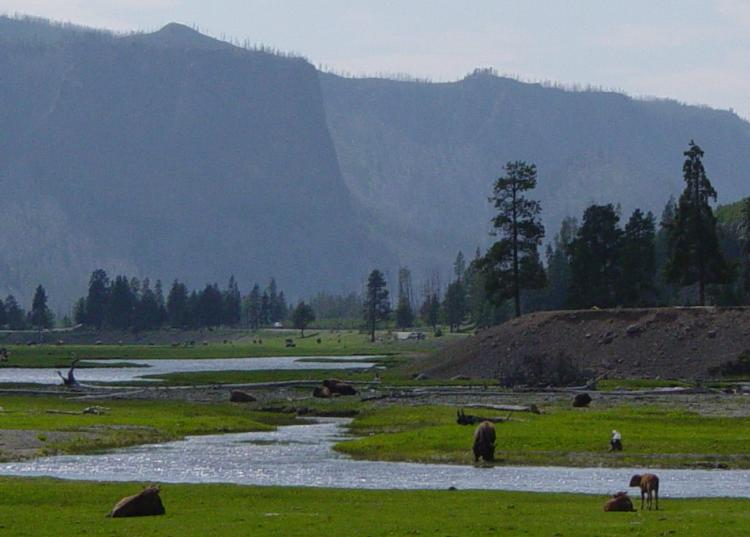
The Greater Yellowstone Ecosystem functions as a complex, interconnected biological and geological system, largely defined by the Yellowstone Caldera's volcanic activity and the vast watershed it encompasses. At its heart is the Yellowstone Caldera, a supervolcano that last erupted approximately 640,000 years ago, creating a landscape dotted with over 10,000 geothermal features, including the iconic Old Faithful geyser and the Grand Prismatic Spring. This geothermal energy influences soil composition and provides unique habitats. The ecosystem's hydrology is dominated by the Yellowstone River and the Snake River basins, which feed into major river systems like the Missouri River and the Columbia River, supporting diverse aquatic life and riparian zones. The ecosystem's large size and relative lack of fragmentation allow for the natural movement of large mammals, such as bison, elk, grizzly bears, and gray wolves, facilitating predator-prey dynamics and nutrient cycling essential for its health. The presence of invasive species and the impacts of climate change, however, present ongoing challenges to its functional integrity.
📊 Key Facts & Numbers
The Greater Yellowstone Ecosystem is staggering in its scale and biodiversity. It's one of the largest temperate ecosystems on Earth. Within this vast expanse, over 60 species of mammals, including an estimated 5,000 bison and 1,000 elk, roam freely. The GYE is home to the world's only continuously wild population of bison and one of the largest grizzly bear populations, estimated at around 700 individuals. Birdlife is equally prolific, with over 300 species recorded, including iconic raptors like the bald eagle and osprey. The ecosystem boasts over 1,100 species of native plants, from delicate alpine wildflowers to towering lodgepole pines. Geologically, it sits atop the Yellowstone Caldera, a supervolcano capable of producing catastrophic eruptions, with over 10,000 geothermal features, including more than 500 active geysers. Annual visitation to Yellowstone National Park alone often exceeds 4 million people, generating hundreds of millions of dollars in tourism revenue for surrounding communities like Jackson, Wyoming, and Bozeman, Montana.
👥 Key People & Organizations
The GYE's existence and management are intertwined with numerous individuals and organizations. Yellowstone National Park and Grand Teton National Park are the core federal entities responsible for managing vast portions of the ecosystem. The National Park Service and the U.S. Forest Service are key federal agencies involved in land management. Conservation efforts are significantly bolstered by non-profit organizations such as the Greater Yellowstone Coalition, founded in 1983, which advocates for the protection of the ecosystem's natural resources, and the Yellowstone Park Foundation (now Yellowstone Forever), a major philanthropic partner. Early scientific pioneers like Ferdinand Vandeveer Hayden laid the groundwork for understanding the region's geology, while figures like George P. Marsh influenced early conservation thought. More recently, scientists like A. Starker Leopold and his committee's report in 1963, the Leopold Report, shaped wildlife management policies within national parks, advocating for natural processes. The reintroduction of gray wolves in 1995, spearheaded by the U.S. Fish and Wildlife Service, is a landmark achievement involving numerous biologists and policymakers.
🌍 Cultural Impact & Influence
The Greater Yellowstone Ecosystem holds immense cultural significance, serving as a powerful symbol of American wilderness and a global icon for conservation. Its dramatic landscapes, from the steaming geysers of Yellowstone National Park to the jagged peaks of the Teton Range, have inspired countless artists, writers, and photographers. Ansel Adams's iconic photographs captured the grandeur of the American West, including scenes from this region, influencing public perception of natural beauty. The GYE is a cornerstone of the National Park System, representing the pioneering concept of preserving natural wonders for future generations, a legacy initiated with the establishment of Yellowstone in 1872. It's a primary destination for ecotourism, drawing millions who seek connection with nature, wildlife viewing, and outdoor recreation. The ongoing narrative of wolf reintroduction and the management of large carnivores like grizzly bears has also fueled public debate and engagement with ecological science, making the GYE a focal point for discussions on wildlife conservation and the balance between human activity and wild nature. Its image is deeply embedded in the American psyche as a representation of untamed wilderness.
⚡ Current State & Latest Developments
The Greater Yellowstone Ecosystem is currently navigating complex challenges and evolving conservation strategies. Climate change is a significant concern, manifesting in increased wildfire frequency and intensity, altered precipitation patterns, and shifts in vegetation that impact wildlife habitats. The recent 2022 Yellowstone floods demonstrated the vulnerability of infrastructure and ecosystems to extreme weather events, forcing temporary closures and highlighting the need for climate-resilient management. Wildlife management remains a critical focus, particularly concerning the management of grizzly bears and gray wolves as their populations expand and interactions with human settlements increase. Debates over hunting quotas for elk and bison, and the management of diseases like chronic wasting disease (CWD) in deer and elk populations, are ongoing. The expansion of human development on the ecosystem's periphery, including housing and resource extraction, continues to fragment habitats and increase human-wildlife conflict. Federal agencies like the National Park Service and U.S. Forest Service, alongside organizations like the Greater Yellowstone Coalition, are actively working on adaptive management plans to address these dynamic issues.
🤔 Controversies & Debates
The Greater Yellowst
Key Facts
- Category
- nature
- Type
- topic